
Prioritization Frameworks for Effective Decision-Making
From Chaos to Clarity: A Deep Dive into Product Prioritization Methods

As product managers, we've all been in that crazy juggling act – handling a ton of tasks, dealing with one feature request after another, and sprinting to meet those crazy deadlines. It's like being in a whirlwind that never stops. But guess what? In the middle of all this madness, there's a superhero move we can pull: prioritization
Prioritization is the North Star of Product Management, guiding us through the storm of competing demands, limited resources, and ever-shifting market conditions. It's not just a tool; it's our superpower.
In this blog post, we'll delve into the world of product prioritization. We'll do more than scratch the surface – we'll take a deep dive into various prioritization methods, explore the common challenges product managers face, share invaluable tips and tricks, and show you how to wield prioritization like a pro. Our goal? To help you maximize the potential of your products and delight your customers.
As Peter Drucker aptly put it, "Efficiency is doing things right. Effectiveness is doing the right things." Our journey today is all about focusing on the right things and aligning them with our strategic goals.
What Steps Should Product Managers Take for Effective Prioritization?
Understand the Company's Goals and Objectives: Prior to utilizing any prioritization technique, product managers must have a solid grasp of the company's goals and objectives, as well as how the product aligns with them. This knowledge will aid product managers in identifying features or ideas that best align with the company's overall vision and objectives.
Identify Stakeholder Requirements: A crucial aspect of prioritization is recognizing the needs and expectations of various stakeholders, including customers, internal teams (e.g., marketing, legal), and other relevant parties. By understanding stakeholder needs, product managers can prioritize features or ideas that have the most significant impact on stakeholder satisfaction, ultimately resulting in a more successful product.
Gather Data: Informed decision-making is key to effective prioritization. Product managers must collect and analyze data to assess the potential impact of different features or ideas. This data-driven approach ensures that decisions are rooted in evidence, minimizing the risk of pursuing low-value initiatives and maximizing the likelihood of success.
Match Prioritization Method with Product Goals: Various prioritization methods exist, each with its own strengths and weaknesses. It is essential for product managers to select the method that best aligns with their product's goals and objectives. Choosing the most suitable method for your specific situation is crucial, as different methods may be more appropriate at different stages of the product lifecycle.
Continuously Evaluate and Adapt the Prioritization Process: Prioritization is not a one-time task; it requires ongoing attention and adaptation. As the product landscape and market conditions evolve, so should your prioritization approach. Product managers should regularly evaluate the effectiveness of their prioritization methods and be prepared to make adjustments as needed. This continuous improvement mindset ensures that your prioritization process remains aligned with your product goals and stakeholder expectations, ultimately leading to better decision-making and more successful outcomes.
Now that we've covered the essential steps for effective prioritization, let's roll up our sleeves and explore the diverse world of prioritization methods and frameworks! 💡
What are the different Prioritization frameworks?
MoSCoW Method
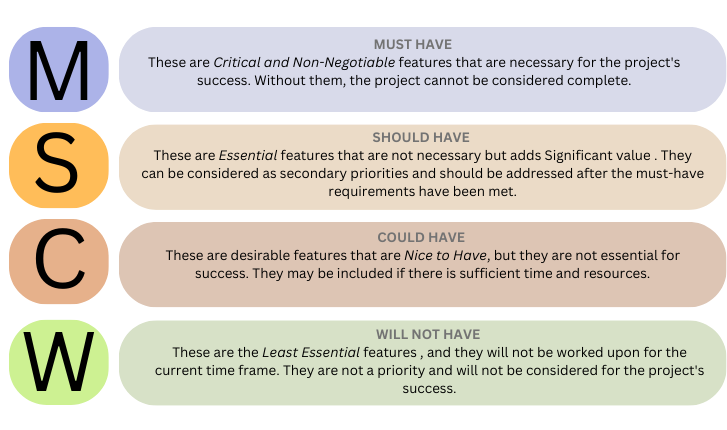
The MoSCoW prioritization method is a widely used approach that helps product managers categorize and prioritize features based on their importance. By establishing a clear hierarchy, it becomes easier to determine which features are critical and should be addressed first, and which ones are less important and can be addressed later or not at all.
Must-Have: These features are critical and non-negotiable for the project's success. Without them, the project cannot be considered complete.
Should-Have: These features add significant value to the project but are not mandatory for success. They may be included if time and resources permit.
Could-Have: These features are desirable but not essential for success. They may be included if there is sufficient time and resources available.
Won't-Have: These features are the least essential and will not be worked upon for the current time frame. They are not a priority and will not be considered for the project's success.
Pros:
Makes it easier to understand the relative importance of requirement 🤓
Great for controlling scope and establishing clear goals 🎯
Promotes open and transparent conversations with stakeholders 🗨️
Handy for projects or releases with tight deadlines ⌛
Cons:
Can be subjective since no data is used for classification 📊
Doesn't take into account impact, effort, or risk factors 🚦
When to use - where you need to manage scope, make quick prioritization decisions in the absence of quantitative data, and align stakeholder expectations while ensuring the project stays on track and prioritizes the most crucial features first
Impact Effort Matrix
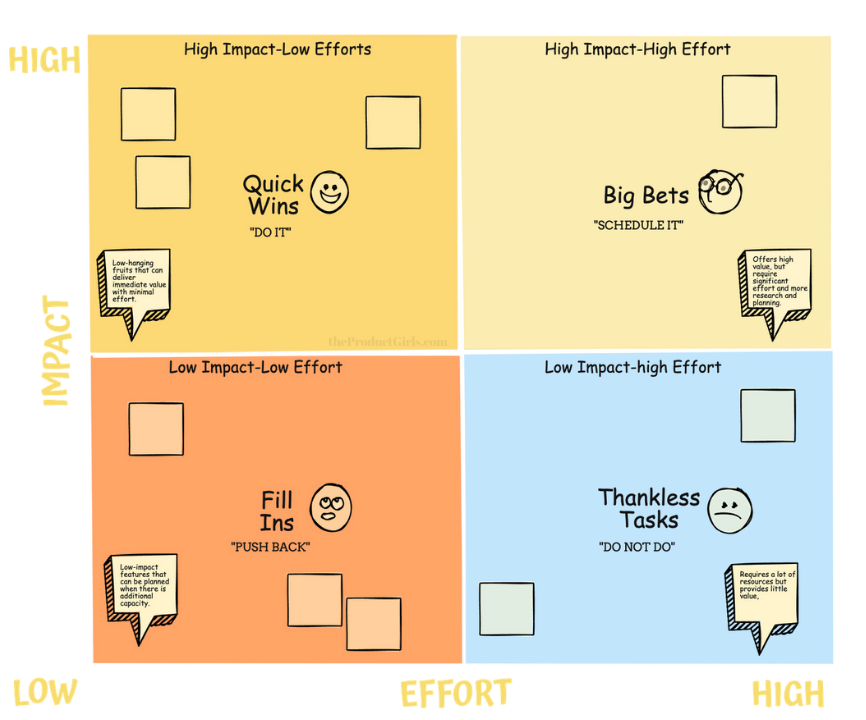
The Impact-Effort Matrix is a prioritization tool that helps product managers make informed decisions about which features or initiatives to focus on based on two factors: the potential impact and the effort required to develop them. This matrix categorizes features into four quadrants based on their impact and effort scores.
Quick Wins (High Impact, Low Effort): "Do It" - These low-hanging fruits deliver immediate value with minimal effort. They should be prioritized for quick results.Big Bets (High Impact, High Effort): "Schedule It" - These features offer high value but require significant effort and more research and planning. Schedule them for later phases or allocate additional resources to address them.
Fill-Ins (Low Impact, Low Effort): "Push Back" - These are low-impact features that can be planned when there is additional capacity. They may be considered for future iterations or sprints.
Thankless Tasks (Low Impact, High Effort): "Do Not Do" - These tasks require a lot of resources but provide little value. It is recommended to avoid these tasks and focus on other more impactful initiatives.
The Impact-Effort Matrix is an excellent method for product managers to visualize the trade-offs between impact and effort, enabling them to prioritize features more effectively.
Pros:
Helps identify quick wins and high-value tasks 🎯
Easy to understand and use 🤓
Encourages collaboration and discussion among the team 👩💻👨💻
Cons:
Doesn't account for other factors, like risk or dependencies 🚧
Can be subjective due to estimation requirements 📈
: High-effort, high-impact tasks might be under-prioritized ⚠️
Not be suitable for prioritizing tasks where other factors, like urgency or strategic alignment, are more critical 🔍
When to use: When you want a simple method to prioritize tasks by balancing their impact and effort, making it easy for the team to identify the most valuable tasks. Useful in team settings for quick, collaborative decision-making and efficient resource allocation. Ideal for initial project planning, especially when you need to allocate limited resources like time or budget effectively.
RICE Method
The RICE method, developed by Intercom, provides a framework for prioritizing features based on their potential impact and effort required to implement them. However, there may be ways to make the RICE method even better.
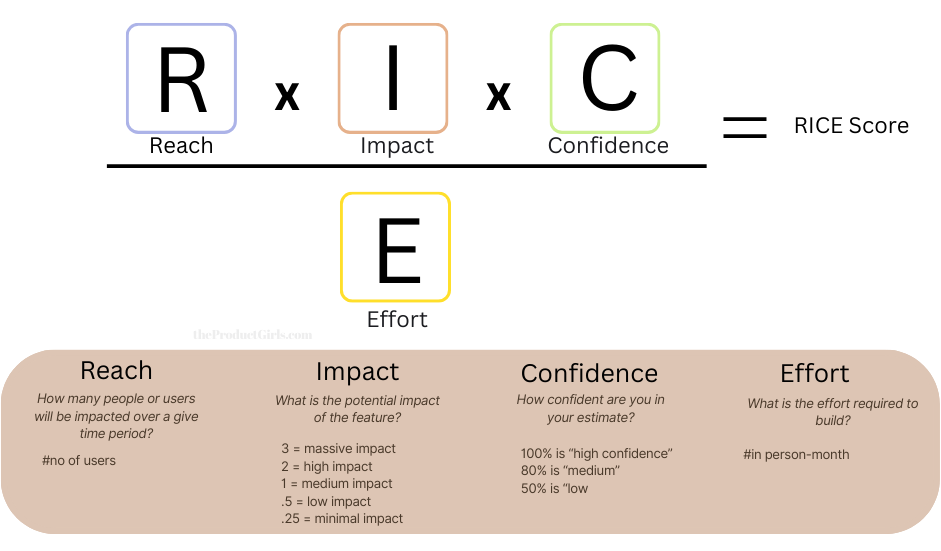
Firstly, let's review the current RICE method. RICE stands for Reach, Impact, Confidence, and Effort. Reach refers to the number of people or users who will be impacted by the feature over a given time period. Impact refers to the potential impact of the feature, which can be scored on a scale of 0.25 to 3, with 3 being the most impactful. Confidence refers to how confident you are in your estimate, with a score of 100% indicating high confidence. Finally, Effort refers to the amount of effort required to build the feature, typically measured in person-months.
As impact is hard to measure, use the scoring system
3 = massive impact
2 = high impact
1 = medium impact
.5 = low impact
.25 = minimal impact
Confidence How confident are you in your estimate? Do you have data to support?
100% is “high confidence”
80% is “medium”
50% is “low
Effort What is the effort required to build? (typically in person-month)
Pros:
Great for balancing multiple factors 🎚️
Considers both quantitative and qualitative aspects ✅
Helps balance short-term and long-term goals by considering immediate impact and the broader reach of a project ⚖️
Scoring system is transparent, making it easier for teams to understand and align on priorities 👀
Cons:
More complex than simpler models, which might be a hurdle for quick decision-making 🧩
Requires estimates, which can be subjective 🤔
Requires more time and effort to analyze and score each project or feature ⏳
May not suit every project or product lifecycle stage, especially simpler ones 🔄
When to use: When you are seeking a thorough, data-focused strategy for decision-making, factoring in multiple aspects. It's particularly effective for long-term strategy and smart allocation of resources.
Kano Model
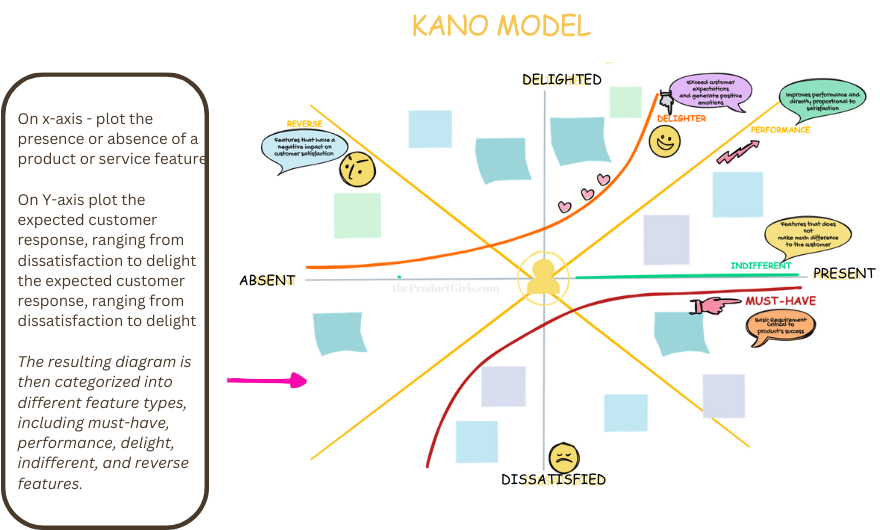
The Kano Model is a prioritization approach used by product teams to assess the degree to which adding a feature to a product roadmap will satisfy customer by evaluating the costs and potential customer satisfaction of each feature.
It involves plotting the presence or absence of a product or service feature on the x-axis, while the expected customer response, ranging from dissatisfaction to delight, is plotted on the y-axis. The resulting diagram is then categorized into different feature types, including must-have, performance, delight, indifferent, and reverse features.
Must-have features: Features that are critical to the product's basic functionality and are essential for customer satisfaction.
Performance features: Features that improve the product's performance, and customer satisfaction increases with an increase in performance levels.
Delight features: Features that exceed customer expectations and generate positive emotions, leading to increased customer loyalty.
Indifferent features: Features that do not significantly impact customer satisfaction, and their absence or presence does not make much difference to the customer.
Reverse features: Features that have a negative impact on customer satisfaction and may lead to customer dissatisfaction.
Pros:
Helps identify delighters and must-haves in your product 🌟
Focuses on customer satisfaction 😃
Useful for differentiating your product in the market 🏆
Recognizes and accommodates evolving customer needs over time 🔄:
Cons:
Requires customer input, which can be time-consuming ⏱️
Doesn't factor in cost or effort 📊
Potential neglect of essential features in favor of delighters ⚠️
When to use: Ideal for developing new products or enhancing existing ones, with a focus on maximizing customer satisfaction and distinguishing your product through a deep understanding of customer preferences.
ICE
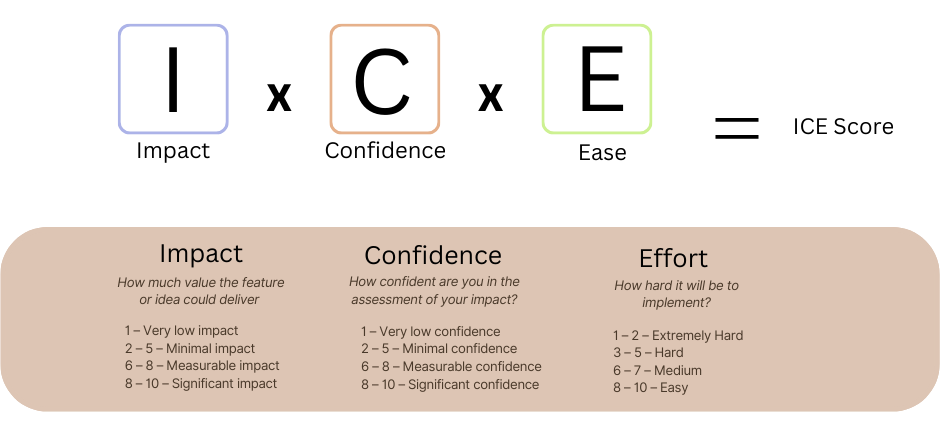
The ICE prioritization technique, created by Sean Ellis, is a fast and straightforward approach for product managers to prioritize features or ideas based on their potential impact, confidence, and ease of implementation .ICE is best suited for relative prioritization and is particularly helpful for agile teams due to its simplicity and speed.
Impact - How much value the feature or idea could deliver
1 – Very low impact
2 – 5 – Minimal impact
6 – 8 – Measurable impact
8 – 10 – Significant impact
Confidence - How much confidence we have on the impact?
1 – Very low confidence
2 – 5 – Minimal confidence
6 – 8 – Measurable confidence
8 – 10 – Significant confidence
Ease - How hard it will be to implement?
1 – 2 – Extremely Hard
3 – 5 – Hard
6 – 7 – Medium
8 – 10 – Easy
Pros:
Simple and easy to use 🎉
Encourages quick decision-making ⏩
Confidence score prompts teams to rely on data and research to back their assumptions. 🚀
Cons:
Lacks a strong focus on customer input 👥
Can be subjective, as it relies on estimates 📝
Focus on ease and quick wins may lead to neglecting projects with long-term benefits but higher initial complexity 🐇
When to use: When you want a quick and easy prioritization method that's especially helpful for fast-paced environment, useful when resources are limited, and there is a need to focus on tasks that can be accomplished with current capabilities
Now that we've explored the steps for effective prioritization and looked at different frameworks, it's important to address the real-world challenges that product managers often face in this process. These challenges highlight the practical complexities and nuances involved in making prioritization decisions in dynamic and ever-evolving product environments
What are the common challenges Product Manager face during Prioritization ?
Balancing Stakeholder Expectations - Involve stakeholders throughout the prioritization process, ensuring their needs are both acknowledged and considered. Clear communication of the reasons behind decisions is key for maintaining transparency and managing expectations effectively.
Evolving Market Conditions and Competitor Actions - Keep a close eye on market trends and competitors to stay agile and adapt your product roadmap as needed. Regularly revisit your prioritization choices to keep them aligned with the current market landscape.
Conflicting Priorities within the Team - Encourage open communication and teamwork during the prioritization process. All team members should feel empowered to share their viewpoints and contribute to a collective decision, fostering a culture of inclusivity and consensus.
Inaccurate or Insufficient Data for Decision-Making- Collect and analyze both quantitative and qualitative data to support prioritization decisions. Leverage customer feedback, market research, and analytics to make informed choices about which features to prioritize.
Limited Resources and Budget Constraints - Adopt a data-driven approach to prioritize high-impact, low-effort features that maximize return on investment. Consider using methods like ICE or RICE to evaluate features based on impact, effort, and potential return.
Tips & Tricks 🛠️
🎯 Keep in mind that prioritizing stuff in product management can be pretty tricky, and no method is perfect. So, to make sure you're making the best choices, try these cool tips to help you stay on top of things and make your prioritization work better:
1️⃣ Keep checking your priorities: Things change all the time—competitors, trends, user feedback, or even your own company. 😮 So, make sure to go back and look at your priorities regularly. This will help you keep your product roadmap fresh and in line with your company's main goals. 🚀
2️⃣ Roll with the punches: Remember, prioritization isn't a perfect science, and there's always some uncertainty. 🤔 Be ready to change things up and tweak decisions when new info comes in or things change. Staying adaptable will help you make better choices. 💪
3️⃣ Chat openly with stakeholders: Make sure to keep talking to stakeholders so you know what they need and expect. 🗣️ Being open and honest helps everyone feel involved, and it makes the prioritization process clearer and more informed. 🤗
4️⃣ Learn from the past: Don't forget that you can always learn from what worked and what didn't in previous projects. 😊 Look back at your past successes and failures, and use those lessons to make better decisions in your prioritization process. Encourage your team to share their experiences, too. It's all about learning and growing together! 🌱💡
In conclusion, choosing the right prioritization framework is influenced by several key factors: the complexity of your projects, available resources, organizational decision-making style, and specific project goals. The effectiveness of any prioritization method, whether it's a singular approach or a blend of different frameworks, hinges on how well it aligns with these aspects. Understanding and adapting to these dynamics will ensure that your prioritization strategy is not only robust but also tailored to the unique needs and objectives of your organization.
If you want to dive deeper into prioritization, I recommend reading some of these blogs:
"Ruthless Prioritization" - This article reveals ruthless prioritization techniques that can supercharge your decision-making, both within and between projects. Learn how to cut through the noise and focus on what truly drives success.
“Introducing DRICE” - In a recent post, Lenny shared an insightful piece on prioritization where Darius Contractor and Alexey Komissarouk introduce the DRICE (Detailed RICE) framework. They go beyond mere theory, offering practical plug-and-play templates and insights from real-life case studies.
🤔 I would Love to Hear: What's your go-to prioritization technique as a product manager, and how has it shaped your success? Also, feel free to share any articles or resources you've found particularly enlightening in this area. Your insights could be a game-changer for someone else! Drop a comment below and let's learn from each other! 👇
🚀 Join my email newsletter theproductgirl
❤️ Get Free PM toolkit at my Gumroad store
👉 Follow me on Instagram for more content @_theproductgirl